You are currently browsing the category archive for the 'Teaching' category.

So, no blogging from me for a while then.  I think I stopped because someone I know requested that I blog about robots again, but I have fallen out with the robots, so no blogging from me…

At some point in this and the next month I hope to reconnect with ideas of communication theory using examples of human-robot communication as illustrations, but I haven’t managed yet.  Meanwhile, I am teaching in an upper level Communication Studies unit and enjoying pretty much every minute of that.  It’s possible that some of my students may drop by the blog this week or next, so I thought I owed them a more recent post.

What bits of information could I share here which have some bearing on the tutorials for next week?

  • My favourite theory uses stories as illustrations, almost all theorists in which I am interested and whose ideas I quote do this
  • John Durham Peters is someone I cite a lot (and he’s quoted in the reading for this week)
  • My life choices and the work I have done can be linked back to stories I have heard that have captured my imagination, from school, through my first degree, at work, in moving to Australia and in my research and teaching

Back to robots soon, yes, I really will get back to the robots… one day…

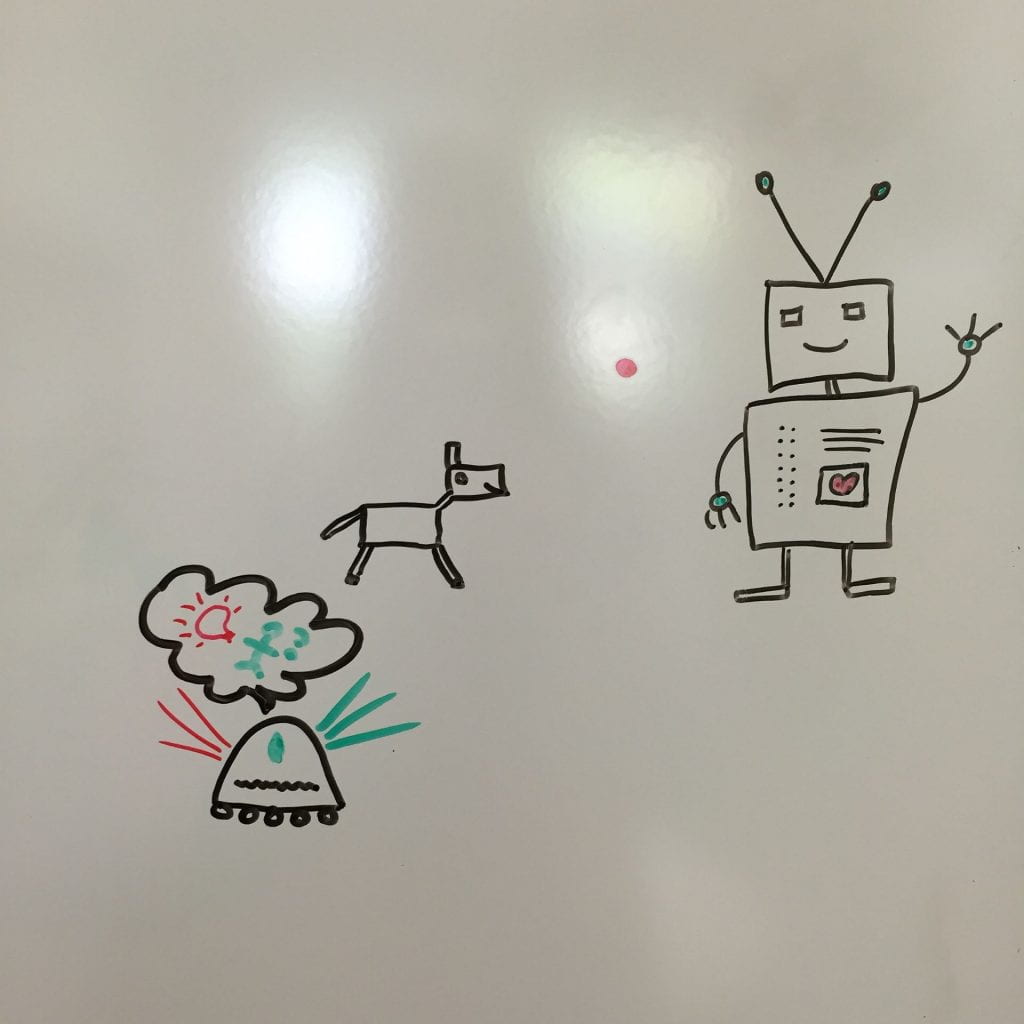
Robot by Jessica Field

As I mentioned in the previous post one of the plenary speakers at the SLSA conference that has just finished in Portland, Maine, was N. Katherine Hayles, who spoke on Friday night.  As this was after my panel I was still recovering from “presentation stress”, so off the top of my head I find that I can hardly remember what happened at this session, except for the fact that it was closely related to the theory found in Hayles’ book, My Mother Was a Computer.

However, I did take some notes :-) !

Given that the conference theme was “CODE”, it was unsurprising that Hayles’ talk stressed the need to take computation into account as fundamental rather than just peripheral to our understanding of the world. Hayles therefore spoke about concepts such as hierarchy versus heterarchy (?), intermediation, complexity and emergence.  In particular she drew on the work of Douglas Hofstadter, not so much on his first tome Gödel Escher Bach, but more on his second, Fluid Concepts and Creative Analogies: Computer Models of the Fundamental Mechanisms of Thought, and spoke about understanding cognition as recognition and the importance of analogy.

Having talked about programming and different codes, Hayles then moved to consider the idea that “the meaning of information is given by the process that interprets it” (Fredkin), and therefore an understanding of objects coming from processes.

These ideas were then brought together as Hayles talked about computers as providing a level of subcognition and the ground for analogies, which then allowed humans to work at the level of creating analogies between analogies.  This supports the understanding that as humans engineer computers, computers re-engineer humans, in a constant process of coevolution.

Then there were some examples, all taken (I think) from Volume 1 of the Electronic Literature Collection, which looks really interesting.

Hayles also talked about the way that in the media intensive environment that young people experience they develop a talent for hyperattention, which does not prepare them to embrace the still more valued ability for deep attention that most university literacture courses stress in the close reading of novels.  This is something I have heard talked about before, and yet I still often hear scholars complaining about their students not reading the novel they have been set each week :-) !

Anyway, I hope that gives some sort of impression of what the plenary contained, incomplete I’m sure, but I hope not incorrect!

between posts.

That’s probably because my research has been having an identity crisis, and I have been trying to sort this out, while also completing curriculum development for next semester.

Curriculum development takes me forever. Maybe that’s just because I am a beginner at this teaching and learning stuff. Maybe that’s just because it’s hard, particularly if you are a reflective practitioner, which of course I must be because I’m a Teaching Intern ;-) .

Anyway, it’s back to research today, with an emphasis on making a workable plan for writing, rather than an outline that looks good until you start trying to do something with it. I have been advised to break what seem to be huge all-encompassing chapters into bite-size chunks. This should work for me better as a writer, but also work for my examiner as a reader. They should find my work easier to chew and maybe swallow, or possibly to spit out in disgust!

The other positive note is that the book I ordered a week and a bit ago should be making its way to Perth by now. This time it’s not just “another one about robots/emotions” to read for my research. It’s about how to write your dissertation in fifteen minutes a day (although the author admits this was a lie to get you to buy the book). Maybe I’m just clutching at straws, but it received good reviews on Amazon, and sounded like it might help with the depression of blank-page-itis.

This blog was created primarily to hold pages of information that I might want to direct people towards. For example, a curriculum vitae and academic portfolio information.

It is vaguely possible that I’ll get around to actually making posts to this blog as well. At least I feel better about this forum, rather than the university managed one that for some reason made me feel like BB was watching me.

Eleanor Sandry

me
PhD Candidate
University of Western Australia
Perth

Twitter

Plurk

Categories